

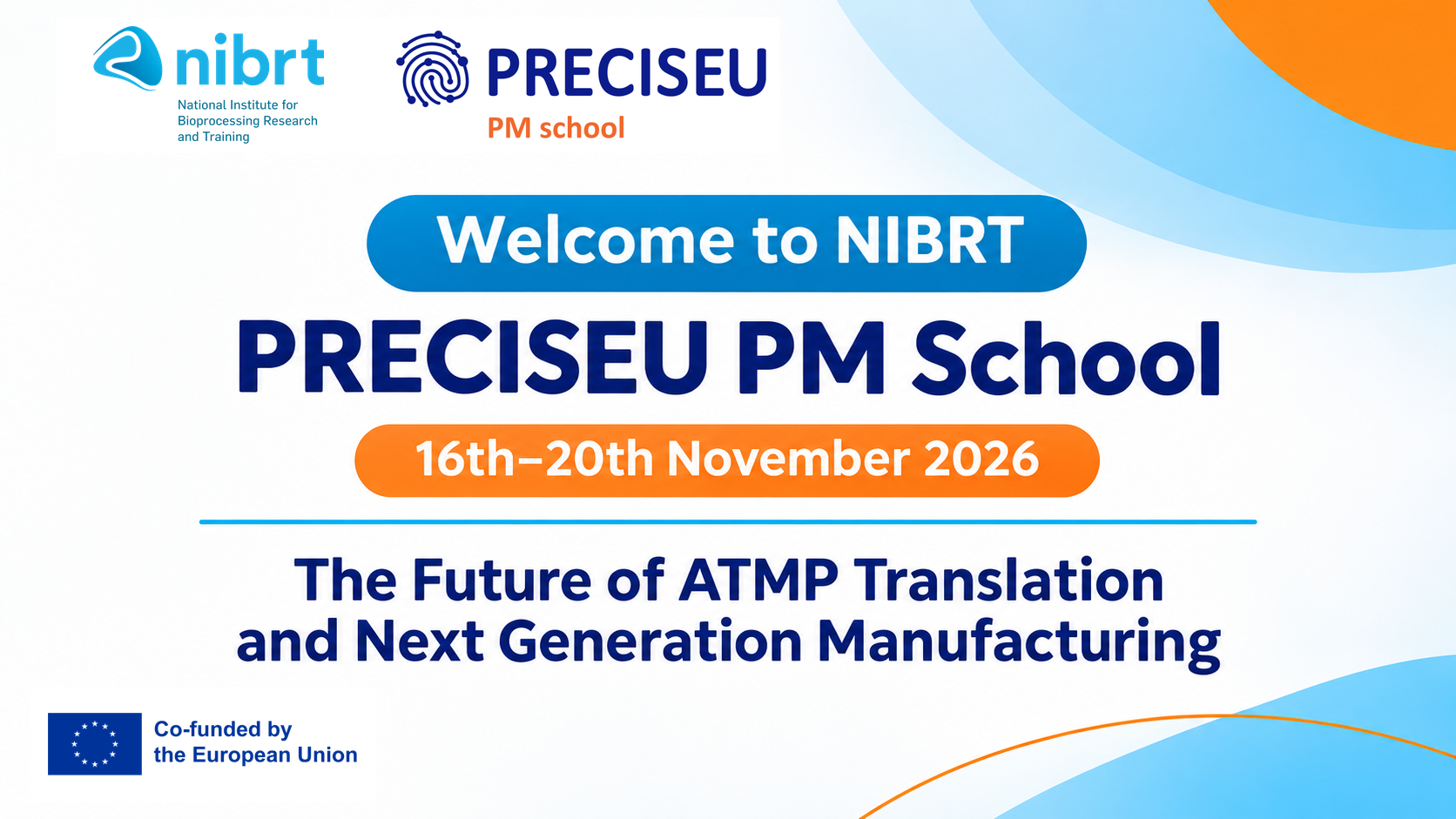
The 4th PRECISEU Personalised Medicine School starts today, 16 November, opening a full week of learning and exchange around one central question: what does it take to move advanced therapies from promising research towards manufacturing, clinical translation and patient application?
Hosted by NIBRT – National Institute for Bioprocessing Research and Training, this year’s edition runs from 16 to 20 November 2026 under the theme: The Future of ATMP Translation and Next-Generation Manufacturing
Rather than approaching ATMP development from a single perspective, the 5-day programme connects several parts of the translation pathway: collaboration models, early characterisation and potency, manufacturing science, cell immunotherapy, RNA medicines and glycobiology.
Monday | Building the right collaborations for ATMP development
The week opens with Dr Friedemann Loos from bioRN Life Science Cluster, leading the session: Collaboration Models for ATMP Development
ATMP development rarely happens within a single organisation. Research groups, clinical centres, specialised infrastructures, industry and other ecosystem actors need to combine expertise and capabilities at different stages of the development pathway. The opening session sets the context for the week by looking at how collaboration can support the advancement of complex therapies.
Monday, 16 November | Hybrid – Dublin & Online
Tuesday | Measuring early, manufacturing smarter
Tuesday brings two complementary perspectives. The morning session, Measuring What Matters Early: Characterisation, Potency and Translation-Ready Advanced Therapy Research, brings together Dr Clair Gallagher, Dr Ioanna Tzani, Dr Julia Serna and Dr Oisin King from CONCEPT. The discussion focuses on the importance of characterisation and potency assessment at an early stage and how these decisions can help prepare advanced therapy research for translation.
Later in the day, Dr John Milne from NIBRT will lead: Trends in Biopharmaceuticals and their Manufacture – Solutions in a Rapidly Changing Landscape. The session shifts the perspective towards manufacturing, exploring how biopharmaceutical production is evolving as technologies, processes and development needs change.
Tuesday, 17 November | Online
Wednesday | Manufacturing science for cell immunotherapy
On Wednesday, Prof Elena Matsa – NIBRT, University College Cork and Rinn Advanced Therapies – will lead: Cell Immunotherapy Manufacturing Science and Technology (MSAT). The session focuses on the manufacturing science and technology underpinning cell immunotherapy and its role in advancing these therapies along the development pathway. For advanced therapies, manufacturing is not simply a final production step. Process understanding, reproducibility and technology development are closely connected to whether an innovative therapy can progress successfully towards clinical use.
Wednesday, 18 November | Online
Thursday | Translating RNA medicines into clinical applications
Thursday is dedicated to: Research Insights into Clinical Translation of RNA Medicines. The session brings together Prof Damien Thompson, Prof Steven Ferguson and Prof Piotr Kowalski from Rinn Pharma and Biopharma, together with Prof Tobias von der Haar from the University of Kent and Jantomarna Therapeutics. Their contributions will explore research perspectives relevant to the clinical translation of RNA medicines and the challenges involved in moving promising approaches closer to patient application.
Thursday, 19 November | Online
Friday | From glycan analysis to glycoengineering
The week concludes with: Applications of Glycobiology: From Glycan Analysis to Glycoengineering. Led by Prof Radka Fahey and Prof Michael Butler from NIBRT, the session will explore applications of glycobiology in biopharmaceutical research and development, connecting glycan analysis with glycoengineering.
Friday, 20 November | Online
Connecting knowledge across the ATMP translation pathway
The structure of this year’s PM School reflects one of the central ambitions of PRECISEU: connecting expertise, infrastructures and innovation ecosystems so that personalised medicine can move more effectively from research towards implementation. PRECISEU brings together regional innovation ecosystems across Europe to strengthen the conditions needed for personalised medicine, including work on advanced therapies, health data, market and patient access, capacity building and cross-regional collaboration. The Personalised Medicine Schools contribute to this work by creating practical spaces where researchers, clinicians, industry professionals, innovators and other stakeholders can exchange knowledge across organisational and regional boundaries.
This week, that exchange is focused firmly on the translation pathway: from early research decisions and collaboration models to manufacturing science, clinical translation and emerging therapeutic technologies.
📅 16–20 November 2026
📍 Dublin & Online
🕒 All programme times are UTC/GMT
Registration link, here: https://us02web.zoom.us/meeting/register/-5RE6zdIQHWYXT6iayQWjQ#/registration
Looking forward to a an informative, powerful and great week!