

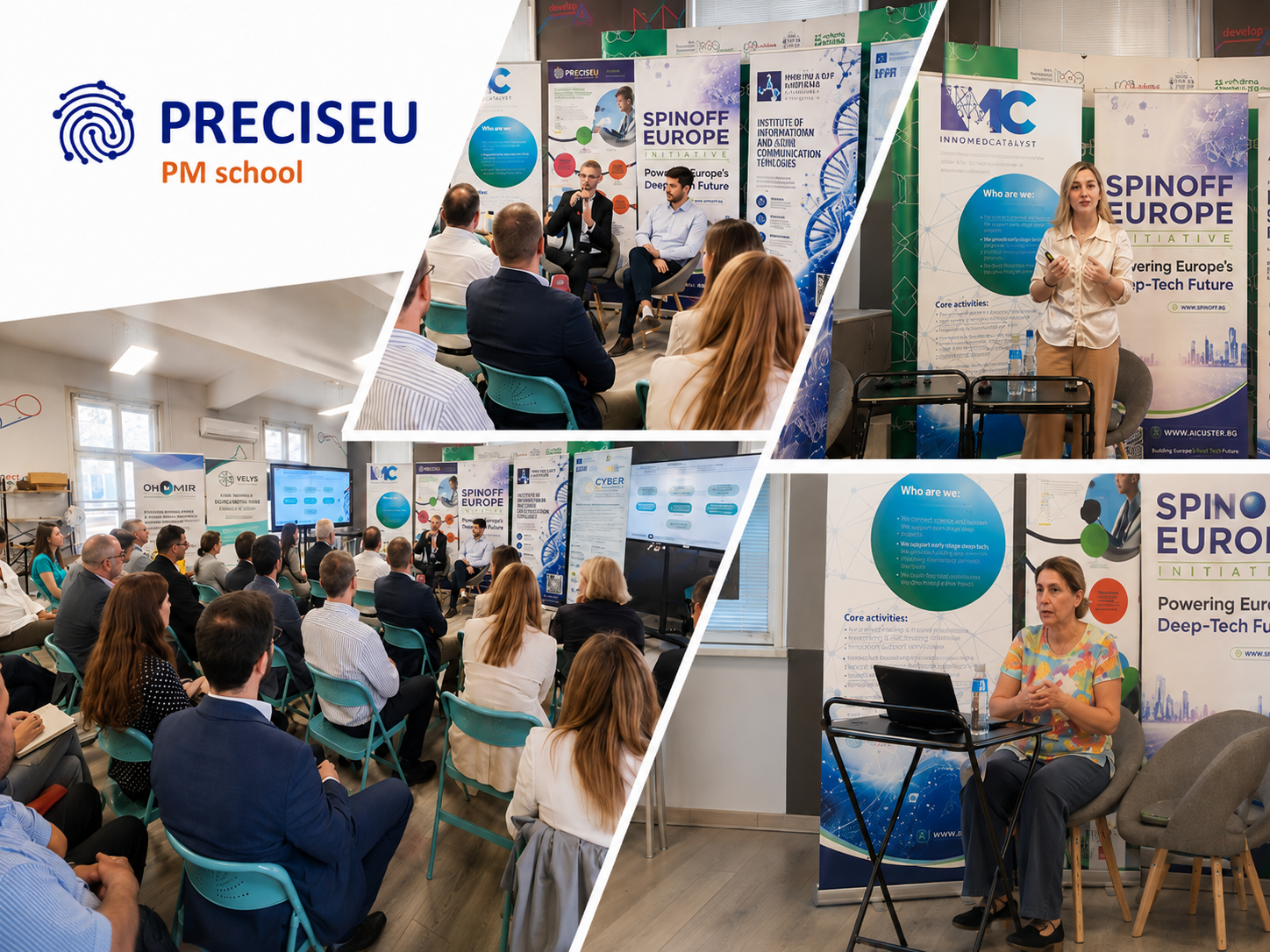
In June 2026, the 3rd edition of the PRECISEU PM School took place in Sofia, Bulgaria, bringing together participants from across Europe for a hybrid training programme dedicated to the practical implementation of personalised medicine.
Hosted by the Health and Life Sciences Cluster Bulgaria, within the PRECISEU consortium, and organised together with the Spinoff Initiative and the Sofia Development Association, the hybrid event (held at Sofia Urban Living Lab and online), was designed as an intensive, multi-day capacity-building programme, supporting participants in understanding how personalised medicine can move from research and policy ambition towards clinical, operational and market implementation.
A training programme focused on real-world implementation
Personalised medicine is advancing rapidly, but its successful adoption depends on much more than scientific progress alone. It requires stronger health data governance, regulatory readiness, clinical translation, funding pathways, technology transfer capacity and collaboration across regional innovation ecosystems.
This was the central focus of the PRECISEU PM School in Sofia.
Across five afternoons, the programme offered expert-led sessions, practical workshops, panel discussions and live demonstrations covering the full lifecycle of personalised medicine — from data and regulation to funding, innovation deployment and future skills.
The programme was designed for a broad audience of early-stage researchers, PhD students and postdoctoral researchers, innovators, startup and spin-off teams, industry professionals in biotech, pharma and health technology, clinicians, healthcare practitioners, policymakers and innovation ecosystem stakeholders.
PM School Sofia in numbers
The 2026 Sofia edition attracted strong interest from the personalised medicine community:
- 270 participants registered
- 178 participants attended
- 49 participants completed the programme
- 49 certificates of participation were issued
- Participants came from 36 countries
- The programme was delivered in a hybrid format, combining onsite participation in Sofia with online access
The hybrid format helped extend the reach of the PM School beyond those able to travel to Sofia, making the training more accessible to participants from different European regions and professional backgrounds.
Five learning tracks for personalised medicine implementation
The programme was structured around five thematic learning tracks, each addressing a key dimension of personalised medicine implementation.
1. Health data, EHDS and interoperability
The first learning track focused on the European Health Data Space, FAIR data, interoperability and data management practices in personalised medicine projects.
Participants explored how better health data governance and interoperability can support personalised care pathways, research collaboration and responsible data use. Sessions also addressed legal and policy frameworks, ELSI guidelines and the role of virtual twins in personalised care.
2. Advanced therapies, regulation and reimbursement
The second learning track addressed Advanced Therapy Medicinal Products, EMA instruments, reimbursement systems and the policy context around the EU Biotech Act.
These sessions helped frame ATMPs not only as a scientific opportunity, but also as an implementation challenge requiring regulatory clarity, infrastructure, reimbursement pathways and stronger readiness across healthcare systems.
3. Funding, spin-off development and investment readiness
The third learning track focused on the steps needed to move health innovation from research towards clinical or commercial deployment.
Participants engaged with funding opportunities, Horizon Europe and Digital Europe programmes, spin-off development, investment readiness and dual-use compliance. This part of the programme was particularly relevant for innovators, startup teams and research groups exploring translational pathways.
4. AI, digital twins and technology-enabled care
The fourth learning track explored how artificial intelligence, digital twins, testing facilities and diagnostics can support personalised medicine.
Sessions covered TEF-Health, AI diagnostics, regulatory readiness, AI for drug discovery, virtual human physiology, molecular biomarkers and Europe’s readiness for ATMP delivery. Together, these topics highlighted the importance of digital and technological infrastructure in moving personalised medicine closer to practice.
5. Intellectual property, technology transfer and future skills
The final learning track focused on the skills, tools and support systems needed to translate innovation into impact.
Participants explored EMA instruments, intellectual property in health data and ATMP projects, technology transfer, access to gene therapies, genomic research infrastructure and future skills for personalised medicine.
This final part of the programme reinforced the idea that personalised medicine implementation depends not only on technology, but also on people, capabilities, institutions and cross-sector collaboration.
Connecting knowledge, ecosystems and implementation capacity
One of the main strengths of the Sofia PM School was its practical focus on translating personalised medicine research into clinical and market impact.
Participants engaged with key implementation challenges such as health data governance under the European Health Data Space, regulatory and reimbursement pathways for advanced therapies, and the funding and investment-readiness steps needed to move a health-tech idea towards a spin-off or market application.
The PM School also strengthened networking across the PRECISEU consortium and the broader personalised medicine ecosystem. Participants had the opportunity to connect with PRECISEU partners, expert speakers, regulators, innovation support actors and the Spinoff EUROPA 2026 community.
By opening into Spinoff EUROPA 2026, the Sofia edition also created an additional pathway for follow-up networking, investment discussions and partnership development.
Strengthening regional innovation ecosystems
The Sofia PM School contributed to PRECISEU’s wider mission of strengthening regional innovation ecosystems and building a stronger European community around personalised medicine.
Personalised medicine cannot be implemented by one type of organisation alone. It requires collaboration between research institutions, healthcare providers, companies, public authorities, innovation support organisations and other ecosystem actors.
The Sofia edition reflected this cross-sector approach by bringing together participants and contributors working across science, healthcare, innovation, policy, funding and technology transfer.
In doing so, the PM School supported one of PRECISEU’s key capacity-building objectives: helping European regions and stakeholders develop the knowledge, connections and implementation capacity needed to make personalised medicine more accessible and effective in practice.
From training event to long-term learning resource
The PRECISEU PM School is more than a one-week training event. It is part of a broader effort to build shared capacity across European regions and to support the practical adoption of personalised medicine.
The Sofia edition created valuable learning content around health data, ATMPs, AI, digital twins, funding, IP, technology transfer and future skills. These themes can continue to support the PRECISEU community beyond the event itself, through recordings, presentations, key takeaways and future training resources.
As PRECISEU continues to develop its training and capacity-building activities, the lessons and materials from the Sofia PM School can contribute to a more structured knowledge base for professionals and organisations working on personalised medicine implementation across Europe.
Through the PM School, PRECISEU continues to help Europe move from personalised medicine as a strategic ambition to personalised medicine as a practical, ecosystem-based reality — one that depends on skills, collaboration, implementation capacity and patient-centred innovation.
This project has received funding from the European Union’s Horizon Europe research and innovation programme under Grant Agreement No 101161301.