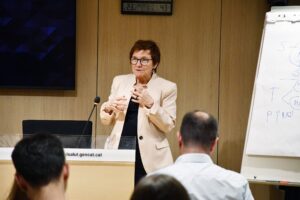

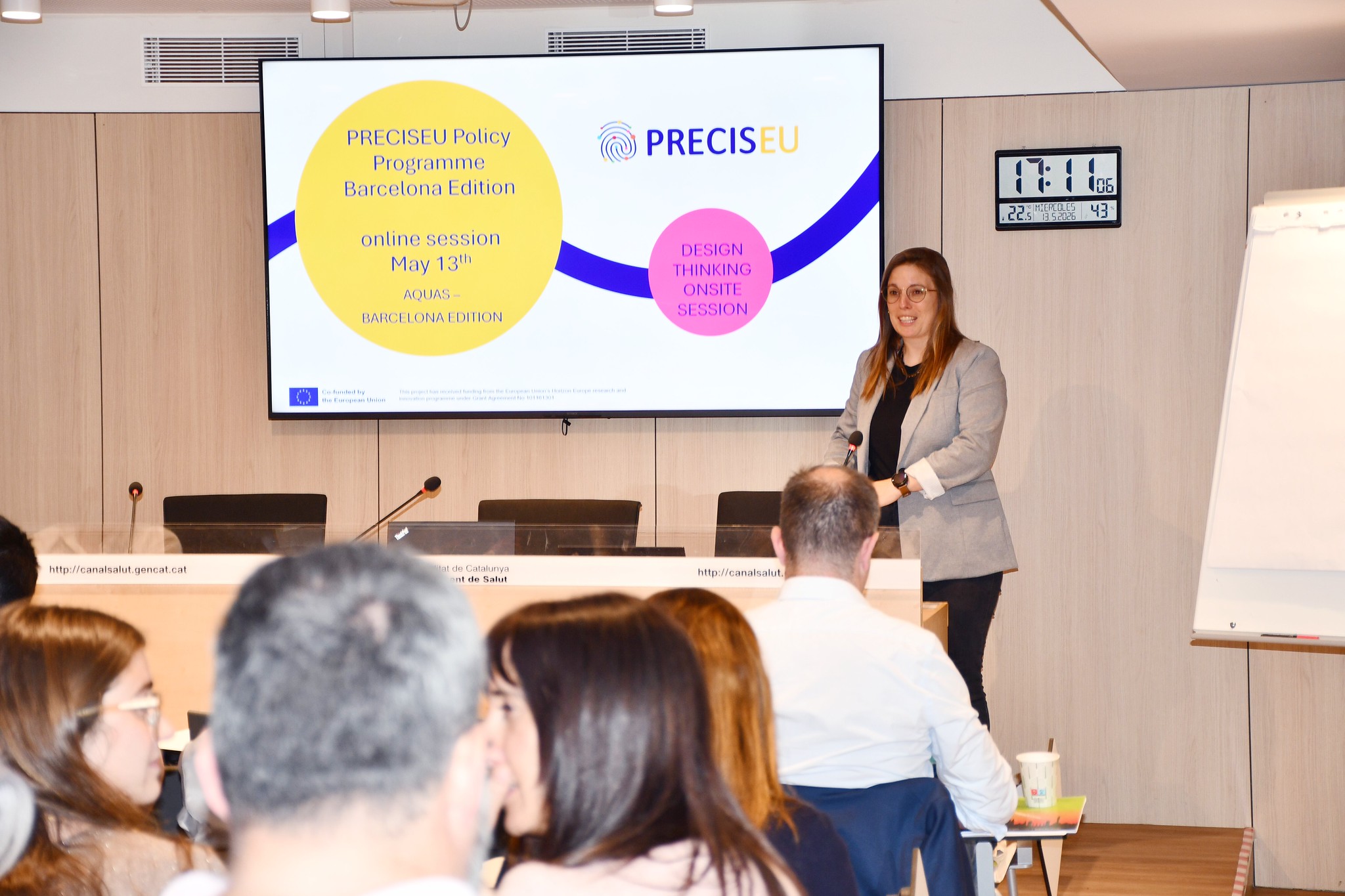
The first pilot edition of the PRECISEU Policy Programme took place in Barcelona on 6 and 13 May 2026, bringing together around fifty public policymakers, healthcare professionals, innovators, industry experts and patient representatives to co-create proposals supporting the adoption of personalised medicine in healthcare systems.
Launched under the European PRECISEU project, the Policy Programme is designed to test new working methodologies between public authorities and health innovation stakeholders. Its objective is to create practical co-creation spaces where different actors from the personalised medicine ecosystem can jointly address regulatory, policy and implementation challenges.
The Barcelona pilot was hosted by Biocat and combined an initial online session with a second in-person session at the Agency for Health Quality and Assessment of Catalonia, AQuAS. The programme applied a design thinking methodology inspired by the Stanford Mussallem Biodesign Center and other international public policy innovation models.
Testing a new policy co-creation methodology for personalised medicine
The first edition served as a proof of concept for the PRECISEU Policy Programme. It tested a multisector methodology aimed at connecting professionals who can anticipate healthcare challenges, contribute to the public agenda and help drive concrete changes in health systems.
This pilot reflects one of PRECISEU’s core ambitions: to support the transition from strategic discussions on personalised medicine to practical implementation pathways at regional level. By bringing together stakeholders from government, healthcare, academia, industry and patient organisations, the programme creates a setting where policy barriers and implementation gaps can be discussed from multiple perspectives.
This approach is especially relevant for personalised medicine, where progress depends not only on scientific and technological advances, but also on the capacity of health systems to adopt innovation in a consistent, sustainable and patient-centred way.
Three thematic tracks: advanced therapies, health data and planetary health
The Barcelona pilot was structured around three thematic tracks:
- advanced therapies;
- secondary use of health data;
- planetary health.
Across these areas, participants worked on regulatory barriers, implementation challenges and opportunities to improve how public policies, regulations, standards and directives are interpreted and applied.
The first session helped participants build a shared understanding of the strategic and regulatory framework for personalised medicine at regional, national, European and international levels. It also created a common basis for analysing health innovation ecosystems, public policy gaps, regulatory barriers and relevant best practices.
The second session focused on applying the design thinking process. Participants worked through the empathise, define, ideate, prototype and test phases to identify applicable solutions aligned with European priorities in advanced therapies, health data and sustainability.
From dialogue to joint proposals
Following the two sessions, participants will continue working in groups over a four-week period to develop joint proposals in each of the programme’s three thematic areas. These proposals are expected to contribute to more flexible, consistent and results-oriented regulatory implementation, while strengthening innovation as a structural component of public health policy.
For PRECISEU, this is an important step in testing how regional ecosystems can work together to address the practical conditions needed for personalised medicine adoption. The Barcelona pilot provides an early model for how policy co-creation can help identify actionable solutions, connect stakeholder perspectives and translate complex innovation challenges into concrete proposals.
A model to be adapted across European regions
After the Barcelona pilot, the PRECISEU Policy Programme is expected to be adapted and rolled out in other European regions, including Flanders, Emilia-Romagna and Sofia between 2027 and 2029.
This regional adaptation is central to PRECISEU’s mission. Personalised medicine cannot be implemented through a one-size-fits-all model. Each region has its own healthcare structures, innovation capacities, policy context, stakeholder networks and implementation barriers. By testing and adapting the Policy Programme across different ecosystems, PRECISEU aims to support mutual learning and the transfer of practices between regions.
The Barcelona pilot therefore marks the beginning of a wider process: building a practical methodology that can help European regions strengthen their capacity to adopt personalised medicine and contribute to more connected, sustainable and patient-centred healthcare systems.
About the PRECISEU Policy Programme
The PRECISEU Policy Programme is part of the project’s broader effort to connect regional innovation ecosystems and support the adoption of personalised medicine across Europe. It brings together stakeholders from the public sector, healthcare, research, industry and patient communities to co-create policy proposals and implementation pathways in areas that are critical for the future of healthcare.
Through this initiative, PRECISEU supports the development of new forms of collaboration between policy and practice, helping regions move from shared challenges to concrete solutions.