

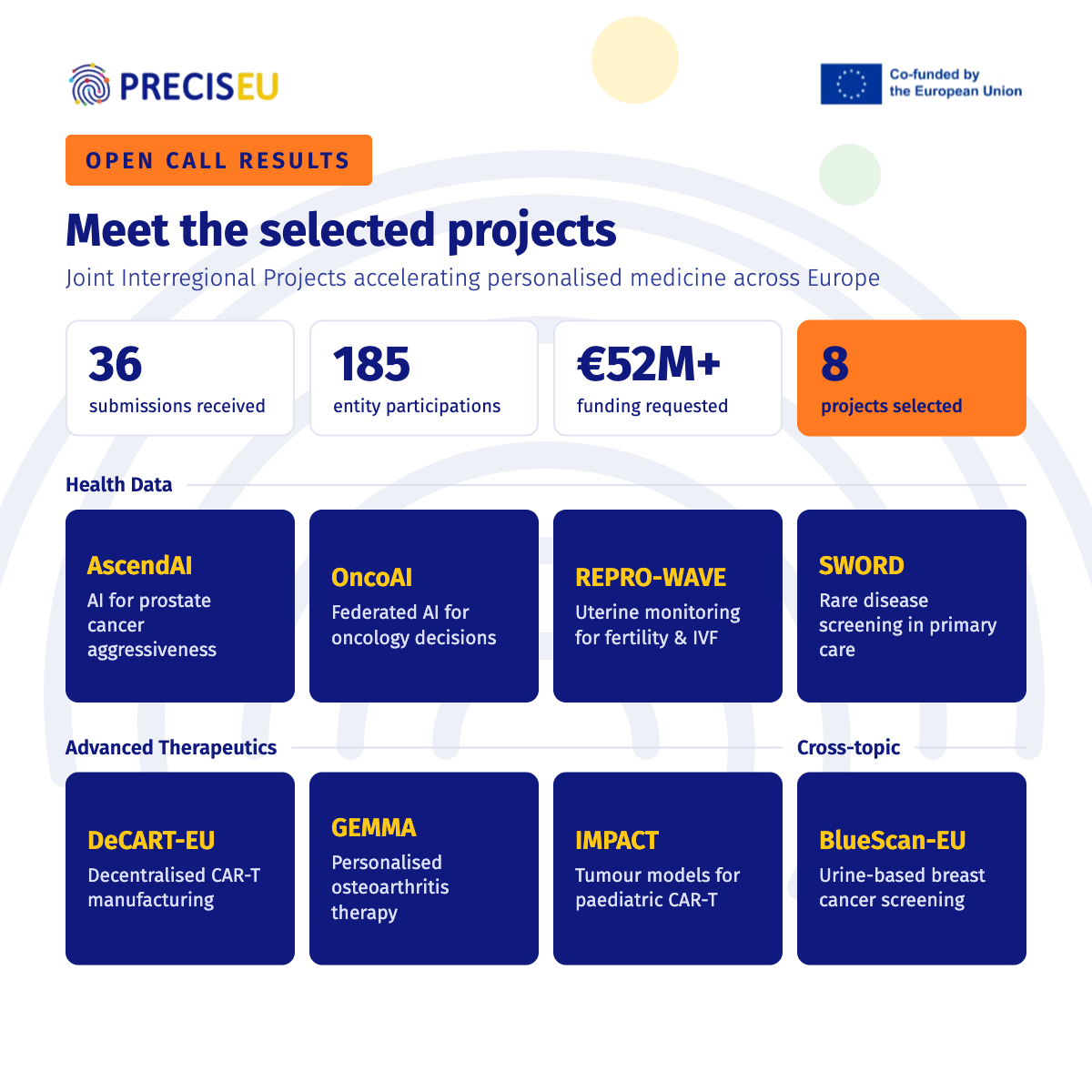
PRECISEU Open Call results: eight Joint Interregional Projects selected to accelerate personalised medicine across Europe
Eight projects, chosen from 32 proposals evaluated by independent experts, will connect companies, hospitals and research centres across all nine PRECISEU funding regions to bring personalised medicine solutions closer to patients.
PRECISEU has selected eight Joint Interregional Projects (JIPs) for funding through its Open Call for personalised medicine. In alphabetical order, they are AscendAI, BlueScan-EU, DeCART-EU, GEMMA, IMPACT, OncoAI, REPRO-WAVE and SWORD.
The eight consortia were selected for conditional funding and are now finalising Grant Agreement Preparation with the Call Secretariat and the participating Funding Agencies. Together they bring 54 partner entries, including 19 SMEs, from all nine PRECISEU funding regions.
The projects cover both priorities of the call: advanced therapeutics and health data for personalised medicine. Each combines complementary expertise from different European ecosystems to move solutions that already work as prototypes closer to everyday clinical use and the market.
What this means for patients
Behind the technical terms are people waiting for a diagnosis, a treatment decision or a therapy that fits them. The eight projects aim to make that wait shorter and care more personal.
For people living with a rare disease, SWORD wants to help family doctors spot the warning signs earlier, wherever the patient lives. For children with cancer, IMPACT explores how therapies can be tested on models grown from a child’s own tumour. AscendAI could give men with prostate cancer and their doctors a clearer picture of how aggressive a tumour is, while OncoAI lets oncologists learn from data held in many hospitals without patient information ever leaving them.
Women’s health is a strong thread in the portfolio. BlueScan-EU is working towards breast cancer screening from a simple urine sample, adapted to each woman’s breast density, and REPRO-WAVE aims to make fertility and IVF care more personal. GEMMA is designing an osteoarthritis treatment that takes differences between women and men into account, and DeCART-EU wants CAR-T cell therapies produced closer to the patients who need them, which could make them easier to access.
The call in numbers
The call drew strong interest across Europe. It received 36 submission records, bringing together 185 partner entries.After screening, 32 proposals went to independent expert evaluation. Together they requested €52.02 million, about 4.5 times the indicative funding envelope of €11.57 million. Eight projects were selected, one in four of those evaluated.
About the Open Call
The PRECISEU Open Call for Joint Interregional Projects opened on 13 April 2026 and closed on 14 June 2026. It was a single-stage call, designed as part of PRECISEU’s Regional Innovation Valley approach and funded jointly by Horizon Europe and the participating regional Funding Agencies.
Proposals could address one or both topics: Advanced Therapeutics, and Health Data for Personalised Medicine. Rather than early-stage research, the call targeted solutions already close to real-world use, at Technology Readiness Levels (TRL) 6–8: tested as prototypes and now ready to be validated with patients, prepared for regulatory approval and scaled up.
Each consortium needed at least three independent legal entities from three different Funding Agency regions, in at least two EU Member States, including at least one SME from a PRECISEU region. Projects could request up to €3 million and must end by 31 May 2029.
Applicants were supported through an information webinar on 14 April 2026, a central helpdesk, regional contact points, a regularly updated FAQ and the PRECISEU matchmaking platform for building consortia.
Ten Funding Agencies from nine regions took part in the call: BIOPRO Baden-Württemberg GmbH (Baden-Württemberg), the Agencia de Transformación Digital Castilla-La Mancha (Castilla-La Mancha), the Departament de Salut of the Generalitat de Catalunya and ACCIÓ (Catalonia), the Region of Crete, Regione Emilia-Romagna, NIBRT (Ireland), Lazio Innova S.p.A. (Lazio), Innovation Agency Lithuania and the North-East Regional Development Agency (North-East Romania).
The eight selected projects
The projects are listed in alphabetical order, which does not reflect the evaluation ranking.
AscendAI (Health Data)
Accelerating the Scaling of prostate-cancer aggressiveness AI to clinical readiness. AscendAI will take an AI tool that assesses prostate cancer aggressiveness from a tested prototype towards a solution ready for clinical use. It combines federated, multicentre clinical validation with trustworthiness assessment and regulatory-readiness work.
Coordinator: Hellenic Mediterranean University (ELLINIKO MESOGEIAKO PANEPISTIMIO), Crete. 8 partners, 28 months.
BlueScan-EU (Advanced Therapeutics and Health Data)
Scaling a urine VOC eNose platform for personalised (density-stratified) breast cancer screening. BlueScan-EU will optimise and clinically validate a urine-based electronic nose that combines volatile organic compound sensing with AI. The aim is breast cancer screening adapted to breast density, while generating reusable FAIR and EHDS-aligned health data.
Coordinator: The Blue Box Biomedical Solutions, Catalonia. 7 partners, 24 months.
DeCART-EU (Advanced Therapeutics)
Decentralized Automated CAR-T-Cell Production for Europe. DeCART-EU will develop a harmonised European framework for decentralised, automated CAR-T manufacturing. It covers GMP-compliant production, digital traceability, regulatory convergence and validation across several sites.
Coordinator: Robert Bosch Gesellschaft für Medizinische Forschung mbH, Baden-Württemberg. 9 partners, 30 months.
GEMMA (Advanced Therapeutics)
GEnder-based personalized Microsponge as Modulatory Adjuvant Platform for Osteoarthritis. GEMMA will develop a sex-informed therapeutic platform for osteoarthritis, based on peptide-loaded hyaluronic acid microsponges. The work brings together bioengineering, molecular analysis and preclinical validation.
Coordinator: IRCCS Istituto Ortopedico Rizzoli, Emilia-Romagna. 3 partners, 30 months.
IMPACT (Advanced Therapeutics)
Integrated Models for Personalised Advanced Cancer Therapy. IMPACT will validate patient-derived microtumours as ex vivo models for testing personalised advanced cancer therapies. Its main use case is CAR-T therapy in paediatric oncology.
Coordinator: NMI Natural and Medical Sciences Institute at the University of Tübingen, Baden-Württemberg. 5 partners, 30 months.
OncoAI (Health Data)
OncoAI: Federated AI for Oncology Decision Support. OncoAI will develop a trustworthy federated AI framework for precision oncology. It connects clinical, imaging and genomic data held by different institutions without moving patient-level data.
Coordinator: Artificial Intelligence Research and Innovation Center AIRI – UNIMORE, Emilia-Romagna. 11 partners, 30 months.
REPRO-WAVE (Health Data)
Interoperable Uterine Electrophysiology Monitoring for Personalised Fertility and IVF Care. REPRO-WAVE will validate continuous monitoring of uterine electrical activity and motility as a new source of physiological data. The goal is more personalised fertility, IVF and frozen embryo transfer care.
Coordinator: OnaWave Medical Limited, Ireland. 6 partners, 24 months.
SWORD (Health Data)
Screening With Optimized Real-world Data for Rare Diseases. SWORD will scale a federated decision-support system that brings rare-disease expertise into primary-care electronic health records. It aims to shorten diagnostic delays and reduce differences between regions.
Coordinator: Vall d’Hebron Research Institute (VHIR), Catalonia. 13 partners, 30 months.
Who applied and who was selected
Health Data was the most popular topic, with 19 of the 32 evaluated proposals. Seven focused on Advanced Therapeutics and six addressed both. The selected portfolio keeps a similar balance: four Health Data projects, three Advanced Therapeutics projects and one covering both.
Catalonia coordinated 13 of the evaluated proposals, followed by Lazio with five, Emilia-Romagna and Baden-Württemberg with four each, and Crete, Lithuania and Ireland with two each.
Applicants included SMEs, research organisations, universities, hospitals, public bodies, NGOs and other companies, with SMEs the largest single group. The eight selected projects involve 54 partner entries, including 19 SMEs, from all nine PRECISEU funding regions, plus one partner from the United Kingdom.
The portfolio spans health-data infrastructures and federated AI, rare-disease decision support, translational cancer models and advanced-therapy manufacturing.
A quality-based and transparent evaluation
Scientific, technical and implementation quality decided the ranking; regional funding rules were applied only afterwards.
The expert evaluation took place between 15 June and 31 July 2026.
Each proposal was assessed individually by three independent experts, who signed conflict-of-interest and confidentiality declarations before receiving any material. They scored each proposal from 0 to 5 on three published criteria: Relevance, Quality and Impact. A proposal needed at least 3 points on every criterion and 10 points overall.
An expert panel then agreed the final scores in a consensus discussion and established a quality-based ranking. The eight highest-ranked proposals form the selected portfolio.
Where requests exceeded a region’s envelope, the Funding Agencies and the Call Secretariat agreed budget or consortium adjustments during Grant Agreement Preparation. These adjustments did not change any expert score or reopen the ranking.
Every applicant received an Evaluation Summary Report. Individual scores and the ranking remain confidential.
From interregional collaboration to implementation
Grant Agreement Preparation confirms each consortium’s legal details, eligible budget and regional conditions. Once the grant agreements are signed, the projects will run for 24 to 30 months, within an implementation window that ends on 31 May 2029.
The selected JIPs mark an important transition for PRECISEU, from ecosystem building, mapping and matchmaking to concrete projects that connect companies, hospitals, research centres and technology organisations across Europe.
The projects will generate practical evidence on the challenges PRECISEU was created to address: interoperable and responsible use of health data, trustworthy AI, clinical and regulatory validation, advanced-therapy manufacturing and cross-border cooperation. Their experience will help PRECISEU identify the barriers faced by real interregional projects and turn them into recommendations for regional and European innovation policy.
PRECISEU thanks all applicants, the independent experts, the participating Funding Agencies and the Call Secretariat at Biocat for their contribution to the call.